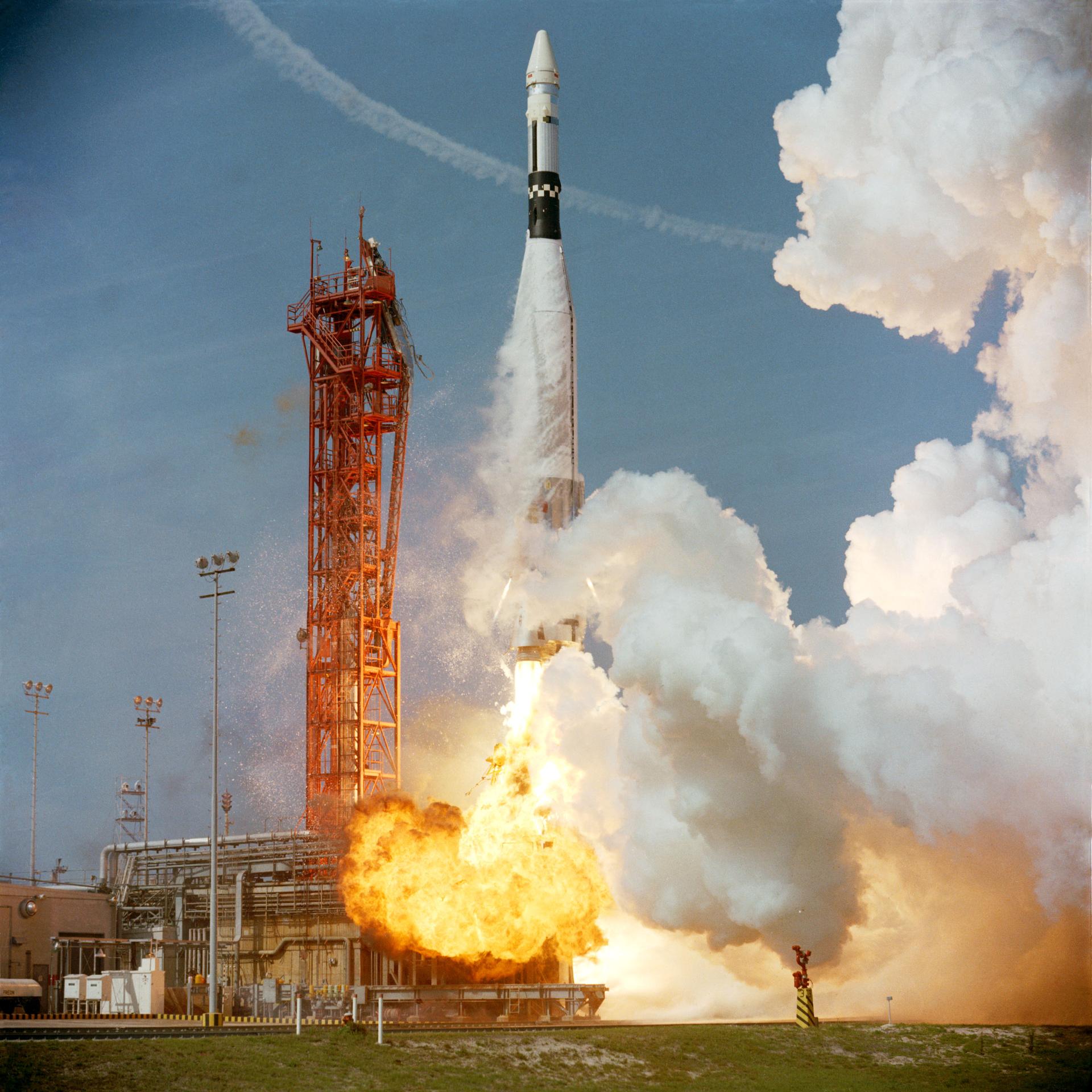
My father's name was Tom Scott. He was a structural engineer, and in March of 1966 he watched a Gemini capsule lift off the pad carrying two men — one of them named David Scott — on the first mission to dock two spacecraft in orbit. I wasn't born yet. He told me about it later, more than once.
Tom Scott believed in engineering the way some men believe in scripture. Not as a career. As a standard. You calculated the load. You verified the assumption. You documented the decision. You tested the result. And then, if the work was sound, men could trust their lives to it.
I grew up understanding that software was the same thing.
Most people don't know the name Earl Bakken. He wasn't a doctor. He was an electrical engineer working out of a garage in Minneapolis in 1958 when he built the first wearable pacemaker — circuits and capacitors, a device small enough to clip to a belt. The man who would wear it was alive. That fact organized every decision Earl made.
Medtronic, the company he founded, eventually added rate-responsive software. Bluetooth monitoring. The discipline held through all of it — because the alternative to discipline, in that domain, is not a bug report. It is a body.
Would you want an AI pacemaker, even if it could reason?
I wouldn't. And I think most people, if they stopped to think about it, wouldn't either. Not because AI isn't capable of remarkable things. It is. But because the value of a pacemaker is not its reasoning. It is its reliability. Its auditability. Its predictability under every condition, documented and verified, every edge case considered before the device ships.
The software industry forgot this.
"Move fast and break things" was never an engineering philosophy. It was an excuse — and we accepted it because the consequences were invisible. Nobody died visibly. Bugs became features. Technical debt became a metaphor instead of a liability.
Agentic AI has accelerated the retreat. We now generate confident, plausible, untested code at scale. More output. Less discipline. And there is enormous pressure — commercial, cultural — to put AI inside the systems we build, as though reasoning were the point of every application.
"Move fast and break things" was never an engineering philosophy. It was an excuse.
Not everyone forgot.
DoD, NASA, and the federal acquisition community never abandoned the discipline. They couldn't — the cost of failure was measured in lives and national security, not sprint velocity. They didn't just consume rigorous software engineering. They largely built it.
MIL-STD-498. The NASA Software Engineering Handbook. The Software Engineering Institute at Carnegie Mellon — funded by the DoD — produced CMMI, the Capability Maturity Model Integration that defined what disciplined software development looked like at scale. Formal requirements tracing. Mandatory test documentation. The insistence that every design decision be recorded before a line of code is written.
The commercial industry called this overhead. The federal world called it engineering.
There is enormous pressure — commercial, cultural — to put AI inside the systems we build, as though reasoning were the point of every application. It isn't. Most software doesn't need to reason. It needs to manage data, process transactions, enforce rules, and produce correct results — reliably, auditably, every time. For that work, AI is not the product. AI is the factory.
Use AI where it reasons well. Use it to design the system, write the code, scan for vulnerabilities, generate the tests, and document every decision. Then let the system it builds stand on its own — conventional, disciplined, auditable. No AI required to run it.
My father would have understood this immediately.
We built Gantry because the industry deserves better. It is the scaffolding — the external discipline that holds the work steady while it's being built. It comes down when the work is done.
What you're left with is yours. No AI required.